Trends · April 26, 2026 · 7 min read
The Near Future of Marketing: What to Realistically Expect by 2028
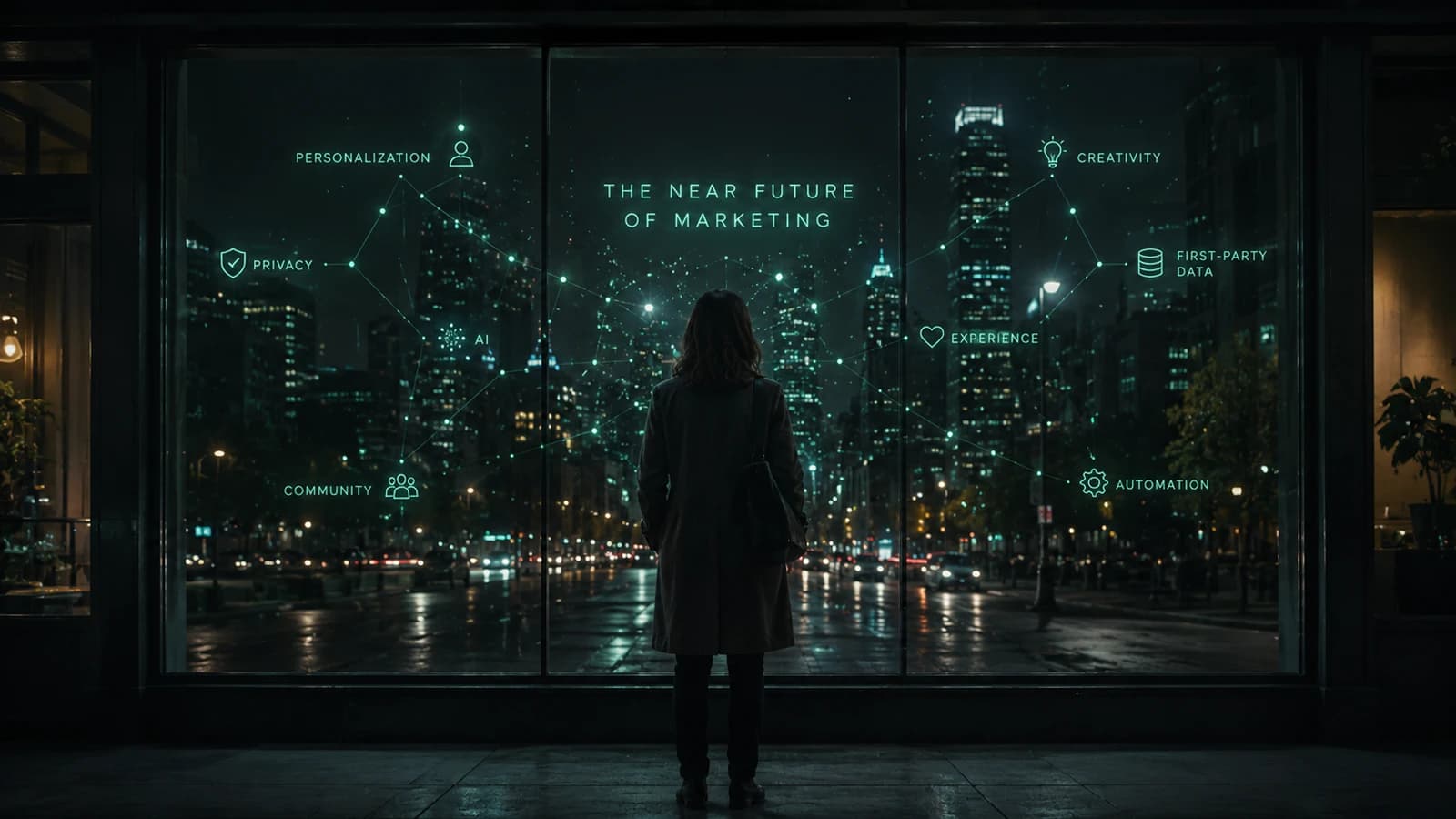
You may have noticed it already: your Google rankings are holding steady, yet the clicks keep thinning out. Customers no longer ask you for the comparison table — they asked ChatGPT and arrived with the answer. If you have met your first client who opened the meeting with “an AI assistant recommended you,” you are already living the subject of this article.
This piece looks at the marketing agenda for the next two to three years — 2026 through 2028 — without the hype. The goal is not to spin futurist scenarios, but to start from what is measurable today and separate three things: what is happening now, what is just starting, and what remains genuinely uncertain.
The short version up front: search turning into an AI-mediated experience is happening now. Agents going shopping is just starting. Where creative automation takes brands is still an open question. Let us take these in order.
Zero-click search is no longer the exception — it is the default
The numbers confirm the feeling. According to Pew Research Center’s 2025 study, users click a traditional result in only 8 percent of searches that show an AI summary, versus 15 percent when no summary appears. SparkToro’s analysis of Similarweb data puts the share of Google searches ending without any click at roughly 68 percent in early 2026. As AI Overviews and AI Mode keep expanding, expecting that gap to close would not be realistic.
The practical consequence: visibility and traffic are no longer the same thing. Prospects now discover you, compare you and shortlist you without ever visiting your site. On the measurement side, that means tracking branded search, direct traffic and how often assistants cite you — alongside organic sessions. On the content side, it means aiming to be quoted accurately even when the click never comes.
From keywords to machine readability
SEO is not dying; its audience is changing. The new reader of your content is a language model as much as a human. What the industry calls generative engine optimization — or answer engine optimization — mostly rests on familiar foundations: structured data (schema.org), pages that answer a question directly, consistent company information, and your brand being mentioned correctly across third-party sources such as press coverage, industry directories and trusted lists. When models decide whom to cite, they weigh consistency across the open web, not claims written inside a single site.
Between now and 2028 we expect this to shift from a specialist niche to standard hygiene. The steps to take today are clear: mark up your services and products with structured data, answer frequent questions explicitly and one at a time, and make sure your details are current everywhere your name appears.
Agents are going shopping — but the wallet stays human
Agentic commerce is the most discussed and least settled topic of the moment. OpenAI launched instant checkout inside ChatGPT in September 2025; as CNBC reported, only around 30 merchants had gone live six months later, and the company had to rethink its approach. Amazon, meanwhile, says its shopping assistant Rufus has reached 300 million users. The picture is clear enough: using AI to research and compare is rapidly becoming routine, while handing an agent the actual purchase is still the exception.
The realistic expectation for the next two to three years is that agents harden into a pre-selection layer between brands and buyers. Prepare accordingly: clean, current product feeds and machine-readable pricing, stock, returns and shipping information. Businesses that already sell through conversational channels — WhatsApp commerce is a daily reality in markets like Türkiye — will find this discipline more familiar than they expect.
Retail media: the shelf has moved onto the screen
The fastest-growing line in advertising budgets is retail media. eMarketer expects US retail media spending to reach about 71 billion dollars in 2026, and industry forecasts see the channel approaching a quarter of global digital ad spend by 2028. This is not a US-only story: in Türkiye, marketplaces such as Trendyol and Hepsiburada run mature ad platforms, and in Europe retailers from Amazon to Zalando are doing the same. Visibility on the marketplace shelf is turning into something that looks a lot like rent.
For brands under cost pressure, the appeal is obvious: whether the user who saw the ad actually bought is measured on the same platform, in a closed loop. Our caution is just as plain: retail media harvests demand, it does not create it. Brands that abandon brand building and move the entire budget to the shelf may find, two years on, that there is little demand left to harvest.
Data and regulation: first-party data won the argument
The long-running “are cookies dying?” debate ended quietly. Google formally shut down its Privacy Sandbox initiative in October 2025; third-party cookies are not being removed from Chrome, but they are increasingly consent-gated and unreliable. The conclusion stands either way: first-party data collected with consent — your CRM, your email list, your messaging channels, your loyalty programme — is the real capital of marketing.
On the regulatory side, one date matters for anyone marketing into the EU: 2 August 2026. From that day, Article 50 of the EU AI Act requires AI-generated or AI-manipulated content to be labelled in a machine-readable way, with fines of up to 15 million euros or 3 percent of global turnover. For exporters selling into Europe — including the growing wave of Turkish brands doing e-export to the EU — and for any team using AI in content production, now is the time to add a transparency step to the workflow. Local data-protection regimes, from the GDPR to Türkiye’s KVKK, already make consent and disclosure part of everyday marketing operations.
As automation gets cheaper, distinctiveness gets more valuable
The marginal cost of producing content is approaching zero. That sounds like efficiency — but when everyone uses the same tools in the same way, the outputs converge. As average content becomes abundant, attention becomes the scarce resource, and attention goes to what is distinctive. The real risk of the coming period is not AI taking your job; it is AI dissolving your brand into an average nobody remembers.
What stays human sits exactly here: positioning and strategy, genuine customer insight, aesthetic judgement, long-term relationships, and the courage to say no. The winners of 2026–2028 will not be the brands that publish the most, but the ones remembered most clearly. Use automation on the production line — not at the decision table.
To sum up: zero-click search and retail media are happening now. Machine readability and agentic commerce are just starting. The net effect of creative automation on brands is still uncertain. There is no need for panic — but there is a need for a plan, and the best moment to make one is while your competitors are still debating.
If you would like to assess how ready your brand is for AI-mediated discovery, retail media and the first-party data era, get in touch — the coffee is on us, the roadmap we build together.